
Building a Membership System That Says "I Don't Know"
Building a Membership System That Says "I Don't Know"
Most failure detectors lie. Not maliciously. They just can't handle uncertainty, so they force a binary answer when they don't have enough information to give one. A node times out, the detector marks it dead, and downstream systems treat that as fact. Sometimes it's right. Sometimes the node was just under load, the network was slow, or a GC pause ate the timeout window. Getting it wrong in the dead direction is usually worse than getting it wrong in the alive direction. You split the cluster, drop connections, trigger failover sequences that are hard to reverse.
STYX is a distributed membership system that returns a probability distribution instead of a boolean. You ask whether a node is alive and it says something like: alive 61%, dead 19%, unknown 20%. If it doesn't have enough information, it says unknown instead of guessing. If it detects a network partition where different parts of the cluster see different things, it refuses to answer at all.
This is a writeup of how it was built and why specific decisions were made.
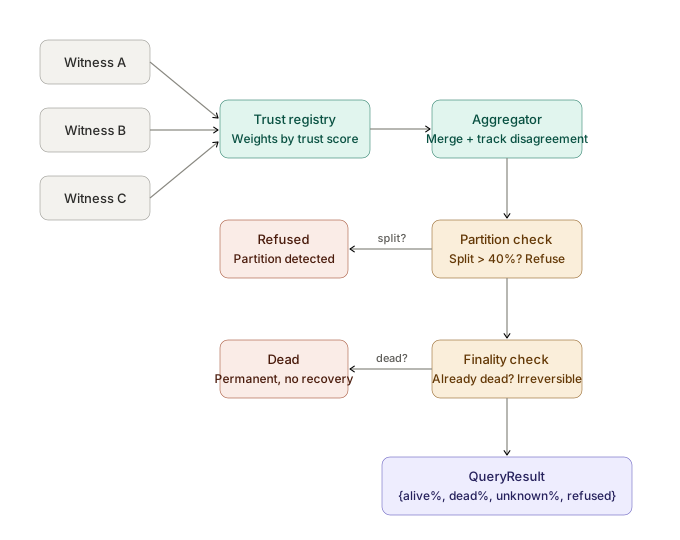
The core problem
Standard health checks have two failure modes that look identical from outside.
The first is real failure: the process crashed, the disk died, the machine is gone.
The second is temporary unreachability: the network path is congested, the process is paused for GC, the machine is CPU-saturated and not responding to probes within the timeout window.
Both look the same to a naive detector. You send a ping, you wait, you get nothing back, you declare death. The problem is that the two cases require completely different responses. Real failure means route around the dead node and start recovery. Temporary unreachability means wait. If you confuse them, you make the second case worse. You trigger unnecessary recovery, create cascading load, and sometimes cause the very outage you were trying to detect.
The fix is to stop treating a timeout as proof of death. It is evidence. Weak evidence. How weak depends on how long you waited, whether your own machine was under load at the time, and whether other witnesses saw the same thing.
Representing uncertainty as a distribution
Instead of a boolean, STYX uses a three-value probability distribution over every node: {alive, dead, unknown}, where the three values sum to 1.
type Belief struct {
    alive   Confidence
    dead    Confidence
    unknown Confidence
}
Confidence is a float64 constrained to [0, 1]. The NewBelief constructor validates that the three values sum to 1.0 within floating-point tolerance before accepting them:
func NewBelief(alive, dead, unknown float64) (Belief, error) {
    sum := alive + dead + unknown
    if math.Abs(sum-1.0) > BeliefSumEpsilon {
        return Belief{}, fmt.Errorf("%w: got %f", ErrBeliefInvalidSum, sum)
    }
    // ...
}
The invariant is enforced at construction time so nothing downstream can accidentally use an invalid distribution. Before any evidence arrives, a node starts with {0, 0, 1}, which is total uncertainty. That is the honest starting state.
A few constraints are baked in as properties the code is written to enforce:
- •Belief is never binary. No node ever reaches
{1, 0, 0}or{0, 1, 0}. The maximum certainty allowed from evidence alone is 90%. - •Unknown is always a floor. Unknown is never allowed to drop below 5%.
- •Conflicting evidence widens uncertainty instead of resolving it.
These are not arbitrary. The 90% cap exists because certainty in distributed systems is rare and expensive to establish. The 5% floor on unknown exists because there is always the possibility of observer error or failure modes that the model does not cover. If a system is going to be conservative anywhere, it should be conservative about claiming certainty.
Evidence types and why they don't all weigh the same
The system collects several types of evidence about a node's liveness.
const (
    KindDirectResponse    EvidenceKind = iota
    KindTimeout
    KindWitnessReport
    KindCausalEvent
    KindSchedulingJitter
    KindNetworkInstability
)
A DirectResponse is the strongest evidence. You sent a probe, got a response, the node is alive right now at that timestamp. The weight starts at 1.0 and decays slightly for high latency. A 1500ms response suggests something is degraded, so the weight drops to 0.6.
A Timeout is the weakest. The code makes this explicit:
// Per Property 4 and 15: timeouts are WEAK evidence, never proof of death.
func NewTimeout(...) Evidence {
    ratio := float64(waitedMS) / float64(expectedMS)
    weight := 0.1
    if ratio > 10.0 {
        weight = 0.3 // Still weak - silence != death
    }
    // ...
}
Even if you waited ten times the expected duration and got nothing, the maximum timeout evidence weight is 0.3. That will not push dead confidence to anywhere near the 85% threshold required to declare death. Multiple timeouts from multiple witnesses might eventually get there, but a single timeout never will.
A CausalEvent is the other strong signal. If the node was observed to have produced a causally linked event, something that could only have been created by that process, then the node was alive at that logical timestamp. Weight is always 1.0 for causal events.
SchedulingJitter and NetworkInstability are modifier evidence. They don't say the node is alive or dead. They say that other evidence should be taken less seriously because local conditions were degraded.
Jitter tracking
One specific problem with timeout-based evidence is that it can be wrong for reasons that have nothing to do with the target node. If your own machine is under load, running hot, doing a GC pause, or processing a large request, your timeouts become unreliable. You might not have sent the probe on time, or the response might have arrived and sat in a queue while your thread was paused.
STYX tracks local scheduling jitter separately and uses it to discount timeout evidence:
func (jt *JitterTracker) GetJitterFactor() float64 {
    // ...
    if maxJitter > 2.0 {
        return 0.1 // Extreme jitter event detected
    }
    if mean > 0.5 {
        return 0.2 // Sustained high jitter
    }
    if mean > 0.2 {
        return 0.5 // Moderate jitter
    }
    return 1.0 - (mean * 2.5)
}
The jitter factor is then applied to every timeout evidence weight before it gets recorded:
ev = evidence.NewTimeout(ts, expectedMS, actualDuration.Milliseconds(), source, target)
ev.Weight *= jitterFactor
// Cap at 0.3 regardless
if ev.Weight > 0.3 {
    ev.Weight = 0.3
}
The result is that timeouts observed during high-jitter periods get almost no weight. The system effectively says: "I know I didn't get a response, but I also know my own machine was misbehaving, so I can't blame the target."
This matters in production because machines that are under load enough to start timing out probes are also usually experiencing scheduling jitter. The two failure modes correlate, and naive detectors interpret both as evidence that the target is failing.
Evidence decay
Evidence gets stale. A direct response from three minutes ago is weaker evidence of current liveness than a response from three seconds ago.
func (e Evidence) EffectiveWeight(now styxtime.LogicalTimestamp, halfLife uint64) float64 {
    age := e.Timestamp.AgeSince(now)
    decayFactor := pow(0.5, float64(age)/float64(halfLife))
    return e.Weight * decayFactor
}
The default half-life is 100 logical time units. Evidence that is twice as old as the half-life has 25% of its original weight. The system naturally shifts from "confident alive from recent responses" toward "uncertain, need fresher data" as time passes without new evidence.
This is important for the partitioned case. If a node becomes unreachable, you do not want the old alive evidence to stay strong forever. The decay ensures that as time passes without new responses, unknown starts creeping back up.
Logical timestamps instead of wall clocks
Wall clocks are unreliable in distributed systems. NTP can jump backwards. Virtualization causes drift. A machine can freeze and then resume with a timestamp that is hours in the past relative to other nodes.
STYX uses Lamport-style logical timestamps throughout:
// Lamport's rule: ts = max(local_ts, received_ts) + 1
func (t *LogicalTimestamp) Update(received LogicalTimestamp) LogicalTimestamp {
    if received > *t {
        *t = received
    }
    t.Increment()
    return *t
}
This captures the "happens-before" relationship between events without requiring synchronized clocks. If event A caused event B, then ts(A) < ts(B). The evidence decay uses logical timestamps, so "stale" means "causally distant" rather than "temporally old."
The tradeoff is that logical time does not translate directly to human-readable duration. You cannot say "this response is 3 minutes old" in logical time units. What you can say is "this response was recorded N events ago." For evidence weighting, that is the right primitive.
Multiple witnesses and aggregation
No single observer has a complete view. STYX is designed to aggregate reports from multiple witnesses, where each witness is another node in the system reporting what it can see.
type WitnessReport struct {
    Witness types.NodeID
    Target  types.NodeID
    Belief  types.Belief
    Trust   TrustScore
}
Aggregation is not a simple average. Two things complicate it.
First, disagreement between witnesses increases uncertainty. If five witnesses all say 90% alive, that is a clear signal. If three say 90% alive and two say 85% dead, that disagreement itself is information. Something unusual is happening, and the right response is to widen the unknown band rather than just average the numbers.
if disagreement > 0.3 {
    reduction := disagreement * 0.5
    avgAlive *= (1 - reduction)
    avgDead *= (1 - reduction)
    avgUnknown = 1.0 - avgAlive - avgDead
}
Second, correlated witnesses do not provide independent evidence. If ten witnesses all have identical reports, that is not ten independent observations. It could be one cluster view replicated across ten nodes. Highly correlated witnesses get their combined confidence reduced by 30%.
Witness trust
Not all witnesses are equally reliable. A witness that consistently gives accurate reports builds trust over time. A witness that consistently gives wrong reports loses trust.
const (
    MaxTrust     TrustScore = 1.0
    MinTrust     TrustScore = 0.1
    DefaultTrust TrustScore = 0.8
    DecayRate               = 0.1
    RecoveryRate            = 0.05
)
Trust decays faster than it recovers. 0.1 per wrong report, 0.05 per correct report. A newly correct witness needs two correct reports to recover from one wrong report. Trust never reaches zero, the minimum is 0.1. A witness with minimum trust still has some influence, just not much.
The trust system interacts with aggregation. Witness reports are weighted by trust score when computing the averaged belief.
Partition detection
A network partition creates a situation where different groups of nodes have genuinely incompatible views of reality. Group A can see node X but not node Y. Group B can see Y but not X. There is no single correct answer to "is X alive?" because it depends on which partition you're in.
STYX detects this pattern and refuses to answer:
func (d *Detector) Analyze(reports []witness.WitnessReport, target types.NodeID) (PartitionState, *SplitReality) {
    // ...
    if aliveVotes > 0 && deadVotes > 0 {
        disagreement := float64(min(aliveVotes, deadVotes)) / float64(total)
        if disagreement > d.disagreementThreshold { // 0.4
            d.state = ConfirmedPartition
            // return SplitReality showing both groups
        }
        d.state = SuspectedPartition
    }
}
If more than 40% of witnesses are in the minority view, the partition is considered confirmed and the oracle returns refused: true with
refusal_reason: "network partition detected - witnesses disagree"This is one of the stronger design choices. A lot of systems would average the conflicting reports and give you a 50/50 distribution, which looks like uncertainty but is actually hiding information. The information being hidden is that the cluster is split. An explicit refusal is more honest. The caller can handle "I don't know" differently from "50% alive, 50% dead."
Death and finality
Death in STYX is irreversible. Once a node is declared dead, it stays dead permanently. If the process restarts and wants to rejoin, it must use a new node ID with an incremented generation counter.
func (n NodeID) Rebirth() NodeID {
    return NodeID{
        Base:       n.Base,
        Generation: n.Generation + 1,
    }
}
This prevents zombie nodes. A node that was declared dead and then came back is, for the purposes of the system, a different node. The generation counter makes old and new identities distinguishable.
The death declaration itself has a high threshold:
const (
    MinDeadConfidence     = 0.85
    MinWitnesses          = 3
    MaxDisagreement       = 0.2
    MinNonTimeoutEvidence = 0.3
)
85% dead confidence from at least 3 witnesses with low disagreement and at least 30% of the evidence being non-timeout. That last constraint is key. If all you have is timeouts, three witnesses that got no responses, that is not enough to declare a node dead. You need at least some positive evidence. Witnesses that tried to communicate and got back something confirming non-responsiveness rather than just absence.
Attempting resurrection always fails:
func (e *Engine) AttemptResurrection(id types.NodeID) error {
    if _, exists := e.dead[id]; exists {
        return ErrResurrection
    }
    return nil
}
There is no API to bring a dead node back to life. The only path is a new identity.
How queries work
The Oracle type is the main interface. You call Query(target) and get back a QueryResult:
type QueryResult struct {
    Target         types.NodeID
    Belief         types.Belief
    Refused        bool
    RefusalReason  string
    Dead           bool
    WitnessCount   int
    Disagreement   float64
    PartitionState partition.PartitionState
    Evidence       []string
}
The query path runs through several checks in order: finality check (is the node already declared dead), partition check (would answering be dishonest given a detected split), aggregation, and confidence threshold check.
The Evidence field in the result is a list of human-readable strings explaining what was considered. Things like "aggregated 7 witness reports", "some witness disagreement detected", "finality: node declared dead". This is useful for debugging because you can see why the system gave the answer it did.
There is also QueryWithRequirement for when you need a specific confidence level:
var StrictRequirement = RequiredConfidence{
    MinAlive:   0.7,
    MinDead:    0.7,
    MaxUnknown: 0.3,
}
If the belief distribution does not meet the requirements, the oracle refuses to answer rather than returning a low-confidence result. The caller decides whether to use a strict or loose confidence requirement based on what they are doing with the answer.
There is a MustQuery that panics on refusal. The comment in the code says "USE WITH CAUTION - defeats the purpose of STYX." It exists for cases where you genuinely cannot handle uncertainty and want to opt into the dangerous behavior explicitly.
The HTTP API
The server exposes five endpoints:
- •
GET /query?target=ID- query node status - •
POST /report- submit a witness belief report - •
POST /witnesses- register a witness - •
GET /health- health check - •
GET /metrics- Prometheus-format counters
A query returns:
{
  "target": 42,
  "alive_confidence": 0.61,
  "dead_confidence": 0.19,
  "unknown": 0.20,
  "refused": false,
  "dead": false,
  "witness_count": 4,
  "disagreement": 0.08,
  "partition_state": "NO_PARTITION",
  "evidence": ["aggregated 4 witness reports"]
}
A report submission:
{
  "witness": 10,
  "target": 42,
  "alive": 0.8,
  "dead": 0.1,
  "unknown": 0.1
}
The server validates that the belief values sum to 1.0 before accepting the report. Invalid submissions get a 400 with an explanation.
What was left out on purpose
A few things were explicitly not built in this version.
Multi-producer channels. The current design is one-to-many: multiple witnesses report, one oracle aggregates. Multiple oracles with consensus is a different, harder problem that would require Paxos or Raft-style agreement on the death declaration. That is out of scope for now.
Built-in persistence. If the oracle process restarts, all the accumulated reports are gone. Starting from scratch with no evidence is the correct behavior from an uncertainty perspective. You genuinely do not know anything after a restart. But it means recovery takes longer. Persistent evidence would require careful versioning and expiry logic.
Automatic probing. The Prober module exists and has a Probe method, but it requires injecting a ProbeFunc. The actual mechanism for sending a probe is not provided. This keeps the core transport-agnostic but means you have to wire it up yourself.
The economics module. There is staking and slashing in economics/economics.go. Witnesses can stake tokens and get slashed for wrong reports. This is not integrated into the main oracle flow. The idea is that economic incentives would prevent Byzantine witnesses from reporting falsely, but it requires a token system that does not exist yet.
The TLA+ spec
There is a formal specification in formal/Styx.tla that models the core invariants. The important ones:
THEOREM Spec => []Property7_BeliefNeverBinary
THEOREM Spec => []Property18_ConfidenceSumsToOne
THEOREM Spec => []Property13_FalseDeathForbidden
THEOREM Spec => Property14_FinalityIrreversible
The spec is simplified in places. UpdateBeliefs just sets a fixed distribution rather than modeling the actual aggregation math. It is sufficient to prove the structural properties but would not catch bugs in the aggregation algorithm itself. Useful for reasoning about the system's invariants, not a full correctness proof.
Current state
The oracle and evidence subsystems work. The Prober needs a probe function injected. The economics module is disconnected. The BFT aggregator with ed25519 signatures is implemented but not wired into the main oracle flow. It sits parallel to the simpler Aggregator.
There is no built-in transport between nodes. Reports have to be submitted via HTTP. A production deployment would need something that periodically sends reports from each node to the oracle about the nodes it can reach. That is two or three hundred lines of gossip protocol that has not been written yet.
The formal spec proves the key invariants on a simplified model. The code implements them in a real system. The gap between the two, the aggregation math, the jitter discount, the evidence decay, is where the interesting bugs will live if they show up.
Practical lessons
Model uncertainty as a first-class type. If your system has places where "I don't know" is a valid answer, build a type that represents it explicitly. Do not use nil, -1, or boolean false. Once unknown is a real value in the type system, you cannot accidentally treat it as known.
Separate evidence from conclusion. The evidence set and the belief are different things. Evidence accumulates. Belief is computed from evidence on demand. This makes it easy to recompute beliefs with different decay parameters, add new evidence retroactively, or explain why the current belief is what it is.
Timeouts are weak evidence by default. Absence of response is not the same as evidence of absence. Build the weak-by-default assumption into the evidence weight, then let multiple corroborating weak signals accumulate into something actionable.
Refusal is a valid answer. Systems that can say "I don't know and won't guess" are safer than systems that always produce an answer. Callers can handle a refusal explicitly. They cannot handle a confidently wrong answer unless they independently verify it.
Logical clocks for causality, not wall clocks. Any time you are comparing "which event came first" across processes, wall clocks will eventually lie to you. Lamport timestamps are simple, cheap, and correct for the causality question.
Death with finality prevents flapping. If a node can come back from the dead with the same identity, membership systems develop weird corner cases around re-registration, stale state, and conflicting views. Making death irreversible and requiring a generation bump on rejoin eliminates the entire class of "is this the same node or a reborn one?" problems.